Major Arcana
Death Tarot Card Meaning
- Element:
- Water
- Astrology:
- Scorpio
- Number:
- 13
Overview & symbolism
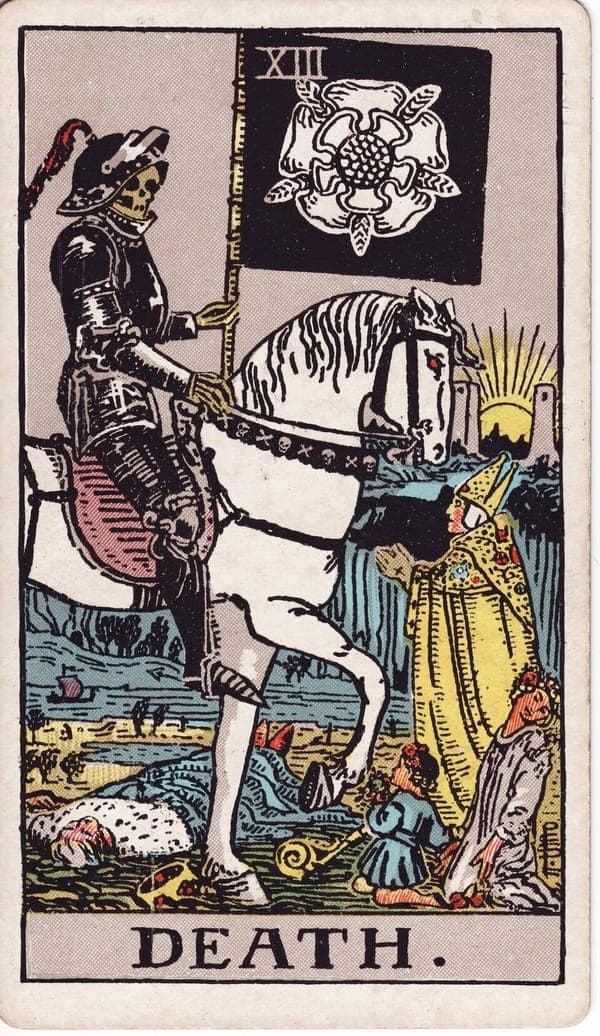
A skeleton in black armor rides a white horse, carrying a banner with a white five-petaled rose — life persisting through death. A king lies fallen, a bishop pleads, a maiden turns away, and only the child looks up openly. Between two towers on the horizon, the sun is rising — or setting; the card refuses to say, because in cycles they are the same.
Upright meaning
- endings
- transformation
- release
- transition
- renewal
Death is tarot's most misread card — it speaks of transformation, not literal dying. Something has completed its natural term: a chapter, an identity, a relationship's old form, a way of living. Upright, it marks the clean ending that makes renewal possible. The card's promise is that what falls away was already finished; its demand is that you stop performing CPR on it. In a symbolic system built for reflection, Death is the season of winter — necessary, impersonal, and always followed.
Reversed meaning
- resisting change
- clinging
- stagnation
- prolonged endings
- fear of release
Reversed, the ending is being resisted — a finished chapter kept artificially alive, change postponed at growing cost, or grief for an old self blocking the new one's arrival. Stagnation here is not peace; it is decay slowed down. The reflective question is simple and hard: what are you refusing to let end, and what is that refusal costing?
Death in Love
Upright: A relationship transforming — an old dynamic ending so a truer one can form, or a completed connection released with grace.
Reversed: Holding a relationship (or its old version) past its natural end. Fear of the ending is prolonging the pain of it.
Death in Career
Upright: The end of a role, path, or professional identity — clearing ground for reinvention. Let the old title go.
Reversed: Staying in what has clearly finished — a role outgrown, a project past saving. The exit is also a door.
Death in Money
Upright: The end of a financial chapter — closing accounts with an old pattern and building differently.
Reversed: Clinging to a failing arrangement or old money habits out of familiarity rather than sense.
Death in Health
Upright: Shedding habits and rhythms that no longer serve — transformation at the level of daily life. Reflective only, not medical advice.
Reversed: Knowing what needs to end but keeping it on the calendar. Reflective only, not medical advice.
Death in Spirituality
Upright: Ego-death in miniature — the periodic dissolving of who you thought you were, which every tradition treats as sacred ground.
Reversed: Clutching an outgrown identity, even a spiritual one. The practice is release.
Death in Shadow work
Upright: Meeting your relationship with endings and impermanence — the root fear beneath many surface ones.
Reversed: What you cannot let die owns you. Where does avoidance of grief masquerade as loyalty?
As advice
Let it end. Mark the ending honestly, grieve what deserves grief, and don't rebuild the old thing out of habit — the space it leaves is the point.
Yes or No?
No. Death generally reads as a no — but a meaningful one: this particular form ends so something truer can begin. The no is the door.
Card combinations
With The Tower, sweeping structural change — ending both chosen and sudden. With Temperance, its intended sequel: integration after release. With the Ace of Pentacles, an ending that seeds a concrete new beginning.
Master Death
Learn it for real with spaced repetition — or ask the AI tutor how Death applies to your situation.
Frequently asked questions
- Does the Death card mean actual death?
- No. In tarot education, Death represents transformation — the ending of a chapter, identity, or life form so that renewal can follow. It is read symbolically, not literally.
- What does Death mean in a love reading?
- A relationship transforming: an old dynamic ending so a truer one can form, or a completed connection being released. Reversed, it points to holding on past a natural end.
- Is Death a yes or no card?
- Usually a no — with the caveat that the ending it signals clears the way for something truer to begin.
Learn all 78 the way you just learned Death
The free 14-day course teaches the deck as a system — one short lesson a day, from your first card to your first confident reading.
Written and reviewed by the ArcanaPath editorial team — see our sources and methods
Last updated July 2, 2026
ArcanaPath is an educational resource. Card meanings are offered for learning and self-reflection — not fortune-telling, and not medical, legal, or financial advice.
Card imagery: Rider–Waite–Smith tarot deck (1909), illustrated by Pamela Colman Smith — public domain.